2027 EWE Schedule
Welcome! We’ve provided two schedule views to help you plan your time at EWE.
The Schedule at a Glance provides a high-level overview of the three-day event, including all events, functions, and activities. Conference sessions are color-coded for easy reference.
The Daily Schedule provides a detailed breakdown of each day’s programming.
Schedule at a Glance
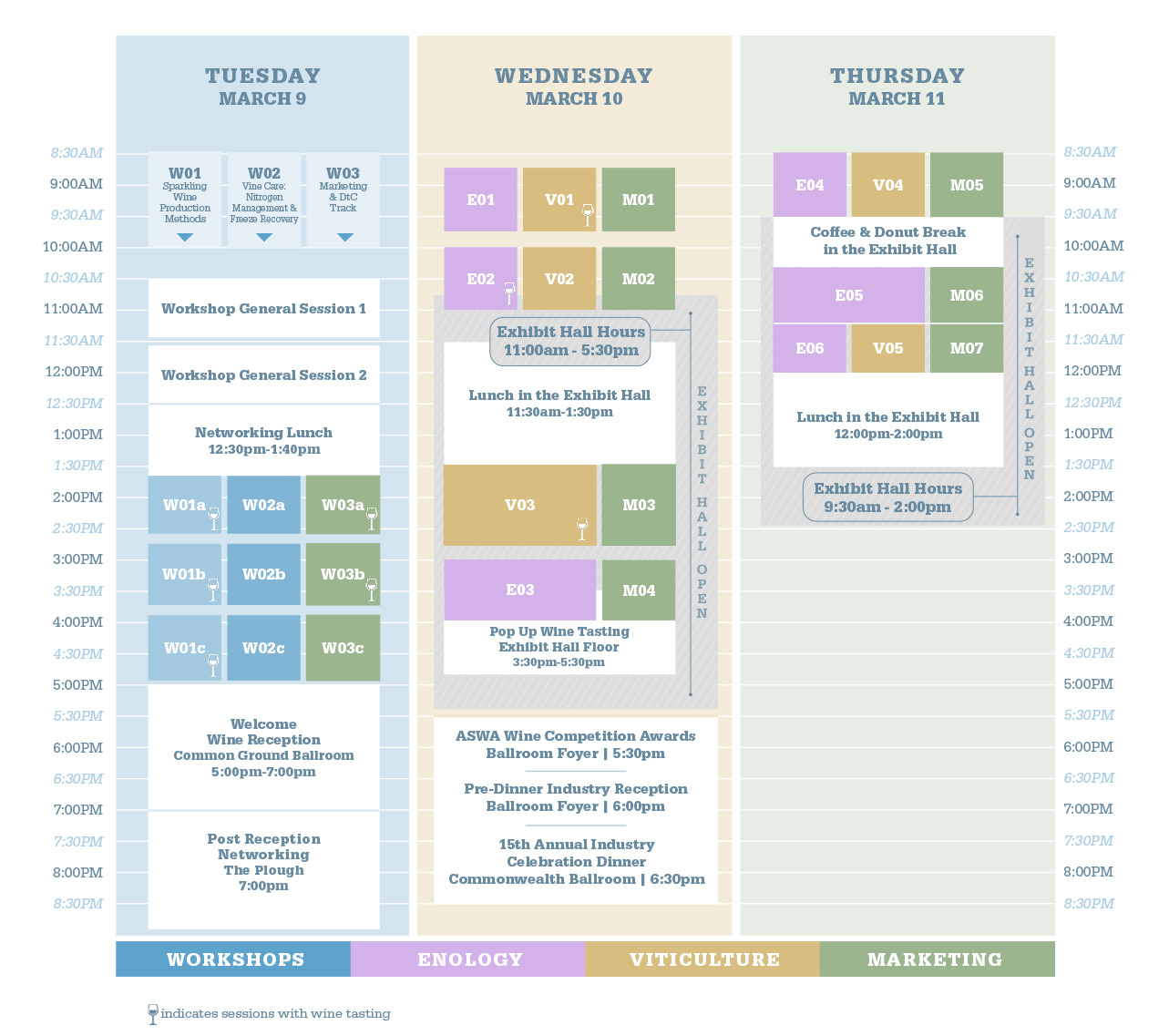 Daily Schedule
Trade Show
The EWE exhibit hall offers wall-to-wall, face-to-face access to the suppliers, equipment, products, and services you want to see. Explore the latest products and technologies, connect directly with industry suppliers, and experience hands-on demonstrations.
Visit the Floor Plan and Exhibitor List to see which companies will be exhibiting at EWE.
Wednesday, March 10 | 11:00 am – 5:30 pm
Thursday, March 11 | 9:30 am – 2:00 pm
Workshops & Conference
Tuesday, March 9 | Workshops
Spend the day exploring a topic in depth, or mix and match sessions to create your own schedule. Lunch is included.
March 10-11 | EWE Conference
The two-day conference features sessions across three key areas of the wine industry:
-
Winemaking (Enology)
-
Marketing
-
Grape Growing (Viticulture)
Use the interactive schedule below to learn more about each session and additional events at EWE. Select one of the three date tabs to view that day’s agenda, then click the + next to any session to read the full description.
All conference sessions are color-coded by track, making it easy to navigate the schedule and find the sessions most relevant to you.
Don’t Miss the Extras! Meals and social events for each day are listed at the bottom of the daily schedule.
Workshop Sessions
10:30 am - 11:25 am | General Session 1 | Don't Wait for the Rebound: Why the Wine Market's Structural Change Demands Innovation
Andrew Adams, Senior Editor, WineBusiness Monthly
The U.S. wine market’s sustained decline is not a downturn to ride out. It’s a structural shift. And it’s arriving just as wineries, like businesses across the U.S. economy, face sharply higher operating costs while consumers pull back on spending. WineBusiness Senior Editor Andrew Adams will discuss the latest market data, what it reveals about where wine is headed, and why wineries must rethink how they make and sell wine to come out ahead. Adams will discuss how wineries are integrating new technology and fresh approaches in sales, marketing, winemaking and grapegrowing.
11:35 am - 12:30 pm | General Session 2 | Who Are You, Really? Confidence, Authenticity, and The East Coast Opportunity
Tyler Balliet, Author, Rebel School of Wine
Morgan First, Creative Director, Rebel School of Wine
The keynote sets an optimistic tone for the track: today’s consumers want authenticity and discovery, which is exactly what the East Coast offers. Reframes obscurity, variation, and smaller scale as the raw material for discovery-minded drinkers, positioning a distinct regional identity as competitive strength rather than disadvantage.
Workshop 1 | Sparkling Wine Production Methods
This three-part workshop will focus on the various production methods used to make many sparkling wines. Parts 1 and 2 will detail the steps in making classic methode champenoise sparkling wines, and part 3 will cover forced C02 and pet-nat production methods.
Workshop 2 | Vine Care: Nitrogen Management & Freeze Recovery
Nutrition study results, and caring for stressed vines following a freeze event.
Workshop 3 | Marketing & DtC
Each session opens with an expert speaker, followed by a diverse winery panel sharing real numbers and real-world examples, then breakouts with peers whose wineries work like theirs, so attendees leave with actionable goals.
1:40 pm-2:35 pm | W01a: Sparkling Wine Processing: Methode Champenoise #1
Steve DiFrancesco, Winemaking Consultant, Winemaking LLC
Mark Wenzel, Founder/Winemaker, August Hill Winery, Illinois Sparkling Co
Mark will share his experiences producing Traditional Method sparkling wines from Midwest-grown hybrid grapes. He will discuss variety selection, harvest parameters, press fraction management, juice clarification, protein stabilization during cold settling, yeast and nutrient selection, primary fermentation, and pre-secondary fermentation adjustments, including cold stabilization, for both white and rosé Traditional Method sparkling wines. Particular emphasis will be placed on how these early decisions influence mousse potential, foam retention, protein stability, wine stability, and consistency in the finished sparkling wine.
Steve will discuss appropriate grape varieties, growing conditions, and harvest parameters for sparkling wine production. Press fractions, juice handling and clean-up comes next. Then, juice adjustments and yeast selection/inoculation, fermentation kinetics, ML, and stabilization come next. Cuvée and reserve blending will be discussed as well.
2:45 pm-3:45 pm | W01b: Sparkling Wine Processing: Methode Champenoise #2
Steve DiFrancesco, Winemaking Consultant, Winemaking LLC
Matthieu Finot, Winemaker, King Family Vineyards
Mark Wenzel, Founder/Winemaker, August Hill Winery, Illinois Sparkling Co
Building upon the base wine preparation covered in W01a, this session follows the Traditional Method process through tirage, secondary fermentation, aging en tirage, riddling, disgorging, reserve wine blending, dosage development, bottling, and release. Mark will discuss practical considerations, common challenges, and production decisions that help preserve wine quality and deliver a consistent, high-quality finished product. Steve will discuss filling into tirage with adjustments and yeast build-up. Then aging en tirage; remuage (riddling), disgorging and dosage. Liqueur d’expedition (dosage) formulations and levels will be discussed. Timing of release after disgorging and dosaging will be discussed, as well. Matthieu will discuss his work as a consultant winemaker with disgorging.
3:55 pm-4:55 pm | W01c: Sparkling Wine Processing: Forced C02 and Pét-Nat
Ben Stamp, Winemaker, Lakewood Vineyards
Matthieu Finot, Winemaker, King Family Vineyards
Ben will discuss his production methods for making quality forced C02 sparkling wines. Matthieu will discuss pét-nat styles and his choice of style at King Family Vineyards, and the production process.
1:40 pm-2:35 pm | W02a: Optimizing Nitrogen Management Under Variable Conditions: Insights from Four Field Trials in Virginia
Drew Harner, Assistant Professor of Viticulture and Extension Specialist, Virginia Tech
Nitrogen plays an important role in grapevine growth, grape production, and fermentation. Vine uptake of nitrogen can be influenced by environmental conditions, and achieving optimal vine nitrogen status can be challenging when conditions vary across and within seasons. This talk will present results from five different field experiments recently conducted in Virginia that evaluated nitrogen fertilization strategies and their impact on grapevine growth, yield, and fruit maturity. It is suitable for new and experienced producers and will provide an overview of nitrogen’s role in sustaining grapevine health and production, insights from our research on how vineyard and vine nitrogen status can be modified, and other considerations for optimal vine nutrition.
2:45 pm-3:45 pm | W02b: Caring for Stressed Vines Following a Freeze #1
Lucie Morton, Viticulturist, Morton Viticulture
Joyce Rigby, Vineyard Manager, Boxwood Estate Winery
Tony McDonnell, Winemaker, Windridge Vineyards
Cain Hickey, PhD, Assistant Teaching Professor of Viticulture, Department of Plant Science, Penn State
Galen Troxell, Winegrower, Galen Glen Vineyards
Davide Creato, Vineyard Manager, Penn’s Woods Winery
Viticulturists Lucie Morton and Cain Hickey join a panel of vineyard managers from across the Mid-Atlantic to discuss how they managed their vineyards following the major freeze last April. Other panelists include: Joyce Rigby of Boxwood Vineyards, VA; Tony McDowell of Windridge Vineyards, MD; Galen Troxell of Galen Glen Vineyards, PA and Davide Creato of Penn’s Woods Vineyard, PA.
3:55 pm-4:55 pm | W02c: Caring for Stressed Vines Following a Freeze #2
Lucie Morton, Viticulturist, Morton Viticulture
Joyce Rigby, Vineyard Manager, Boxwood Estate Winery
Tony McDonnell, Winemaker, Windridge Vineyards
Cain Hickey, PhD, Assistant Teaching Professor of Viticulture, Department of Plant Science, Penn State
Galen Troxell, Winegrower, Galen Glen Vineyards
Davide Creato, Vineyard Manager, Penn’s Woods Winery
The panelists above will detail their techniques with prevention and mitigation prior to last April’s freeze, then trunk renewal and crop estimation for the 2026 season. They will also detail their techniques with shoot selection and canopy management, yield management for 2026 vs. regular seasons, and winter pruning for the 2027 dormant season based on the 2026 season.
1:40 pm-2:35 pm | W03a: Staff Training, Authenticity, and Experience, Part 1
Matt Brown, Founder, MWJ Brown Consulting
Tyler Balliet, Author, Rebel School of Wine
Morgan First, Creative Director, Rebel School of Wine
Hospitality as three connected levers: designing spaces that reflect authentic identity, hiring and onboarding staff who can carry it, and building experiences that over-deliver for their target guests. Attendees define their true audience, build a “train-the-trainer” approach, and workshop their own bottle’s pour live as a group exercise. Bring a bottle of wine for the interactive session.
2:45 pm-3:45 pm | W03b: Staff Training, Authenticity, and Experience, Part 2
Matt Brown, Founder, MWJ Brown Consulting
Tyler Balliet, Author, Rebel School of Wine
Morgan First, Creative Director, Rebel School of Wine
Hospitality as three connected levers: designing spaces that reflect authentic identity, hiring and onboarding staff who can carry it, and building experiences that over-deliver for their target guests. Attendees define their true audience, build a “train-the-trainer” approach, and workshop their own bottle’s pour live as a group exercise. Bring a bottle of wine for the interactive session.
3:55 pm-4:55 pm | W03c: Will the Supreme Court Take Up the Three-Tier System — and What Would It Mean for Your Winery?
Michael Kaiser, Executive Director, WineAmerica
Matt Brown, Founder, MWJ Brown Consulting
Tyler Balliet, Author, Rebel School of Wine
Morgan First, Creative Director, Rebel School of Wine
Will the Supreme Court rewrite the tree-tier system? In 2026 the Sixth Circuit struck down Ohio’s ban on out-of-state retailer shipping, while the Ninth Circuit’s decision upholding Arizona’s version still stands. Ohio has asked the Supreme Court to settle the question. Veteran beverage-alcohol attorney John Hinman and WineAmerica Executive Director Michael Kaiser join Tara Good for a candid conversation about where the cases stand, how the Court could respond, and what each outcome could mean for the shipping rules your DtC program depends on. The session opens with a brief update from TTB.
Meals & Social Events
Tuesday, March 9th
9:30 AM – 12:00 PM | Coffee Break | Registration Foyer
12:30 PM -1:40 PM | Networking Lunch | Commonwealth Ballroom
5:00 PM – 7:00PM | Welcome Wine Reception | Common Ground Ballroom
Join us at this perennial favorite as we gather together with old friends and new to sample wines from around the Eastern region.
7:00 PM | Post-Reception Networking Event | The Plough at the Marriott
Continue the evening networking with fellow attendees. Show your EWE badge to receive $2 off on wine by the glass.
Thank you to our 2027 Welcome Wine Reception Sponsors:
Enology
Viticulture
Marketing & DtC
Enology | Overview
These sessions will focus on the role of oxygen as a catalyst either for microbial spoilage or as an unorthodox tool for winemaking in hyper-oxygenation with reductive handling for white and rose wines.
Viticulture | Overview
These sessions focus on sustainability through cultivar selection, and disease management of ripe rot. The hybrid cultivars featured here are impressively sustainable, with a variety of features like later budbreak or freeze damage recovery, better than average disease resistance, winter hardiness and good yields. Additionally, they also feature high wine quality, comparable to vinifera standards.
Marketing | Overview
Each session opens with an expert speaker, followed by a diverse winery panel sharing real numbers and real-world examples, then breakouts with peers whose wineries work like theirs, so attendees leave with actionable goals.
8:45 am-9:45 am | E01: Case Studies on Winery Sanitation
Molly Kelly, Ph.D., Enology Extension Educator, The Pennsylvania State University
This session will provide an overview of proper sanitation practices including methods to determine efficacy. In addition, Molly will discuss a three-year sanitation monitoring study of four PA wineries. Successes and failures will be presented as well as lessons learned.
10:00 am-11:00 am | E02: Hyper-Oxygenation/ Reductive Handling For Whites And Rosés
Federico Casassa, Ph.D. Professor of Enology & Wine Sensory Analysis, Cal Poly San Luis Obispo
Oxidative vs. reductive juice handling sets the phenolic, antioxidant, and yeast environment before fermentation. This presentation integrates work with Grenache Blanc, Loureiro, Vermentino, Albariño, and also aspects relevant to rosé juice. We compare reductive processing—early SO2, ascorbic acid, inert gas and, when appropriate, glutathione—with deliberate hyper-oxygenation before fermentation.
The latter promotes removal of oxidized phenolic material during settling. Reductive processing conserves glutathione and other nucleophiles but can increase the probability of sulfur-driven reductive characters when fermentation conditions are not well managed.
Different ORP trajectories during juice handling will be shown and discussed. The practical message is that reductive vs. hyper-Ox handling is a useful choice contingent upon cultivar, fruit health, phenolic load, desired style, color target, solids, and anticipated aging. A decision framework for choosing a protective or hyper-oxidative program will be provided—and for avoiding the least predictable option: partial, uncontrolled oxidation.
3:00 pm-4:00 pm | E03: Importance of Measuring Dissolved Oxygen: A PA Study
Molly Kelly, Ph.D., Enology Extension Educator, The Pennsylvania State University
The impact of dissolved oxygen (DO) on wine quality will be discussed, including mitigation techniques. Molly will present preliminary findings of a study; measuring DO throughout the winemaking process. She will also discuss DO bottling line audit results and techniques to reduce oxygen pickup at this critical stage.
8:45 am-9:45 am | V01: Quality, Sustainable Hybrids #1: Regent and Arandell
Dennis Rak, Double A Vineyards Inc. (Arandell)
Paul Briede, Owner, Briede Family Vineyards (Arandell)
Loretta Briede, Owner, Briede Family Vineyards (Arandell)
Eric Amberg, Owner, Amberg Nurseries, LLC (Regent)
Mario Mazza, General Manager & Vice President, Mazza Wines (Regent)
Emmett Reed, Winemaker, Laurentia Vineyard & Winery (Regent)
In this session Eric Amberg will discuss Regent with client Mario Mazza and Emmett Reed, and Dennis Rak will discuss Arandell with husband-wife clients Paul and Loretta Briedé.
Arandell, a recent red Cornell hybrid, is highly resistant to both mildews, and has an elegant, complex wine character. Regent combines late budbreak with early ripening, and Chambourcin flavors with higher tannin levels.
Emmett Reed’s presentation will focus on the growing side of Regent, touching on site selection, climate compatibility, disease resistance, and wine-growing integration in the Grand River Valley, Ohio. There will be approximately 7 slides showing the climate data, ripeness levels, and finished wine products. Slides will include photos of the 2026 growing season and resulting wines.
10:00 am-11:00 am | V02: Managing Ripe Rot in the Vineyard
Mengjun Hu, Associate Professor of Plant Science, University of Maryland
This presentation concerns grapevine cluster ripe rot and its effective management. It covers the basic biology of the disease and research findings from multi-year field trials that led to novel and easy-to-adopt control strategies, with emphasis on fungicide timing and choices. It is targeted at growers and vineyard managers at all levels.
1:45 pm-2:45 pm | V03: Quality, Sustainable Hybrids #2: Leon Millot, Chardonel and Chambourcin
Mel Goldman, Owner, Keuka Lake Vineyard (Leon Millot)
Tony McDonnell, Winemaker, Windridge Vineyards (Chardonel, Chambourcin)
A wine from the French hybrid Leon Millot (2010) by Keuka Lake Vineyard won the New York Governor’s Cup in 2011. Chardonel has Chardonnay as a parent, comparable wine quality, better hardiness, disease resistance and crop levels, and Chambourcin has been a reliable and versatile red hybrid across the Mid-Atlantic for 40 years.
Mel Goldman will discuss Leon Millot. This hybrid consists of two clones: Rouge (the Foster clone) and Noir (the Boordy clone). They are both early to bud and early to harvest, but pretty certain to ripen adequately in almost any year. The Foster clone’s tight clusters make it more prone to rot when the fall is rainy. The Boordy clone, with its loose clusters, is hardier and does well even in rainy harvest seasons. When frost damage is close to budbreak, both clones produce secondaries, though the crop is much smaller than it would otherwise be. That was the case with this year’s April 21st frost. We will also taste the difference between a rainy fall Leon dominated by the Boordy clone versus a sunny harvest where the Leon is a blend of the two clones.
Tony McDonnell will discuss his experience with Chardonel and Chambourcin in the 2026 vintage and beyond. Specifically, he will be addressing the characteristics of these varieties which make them more suitable for growing in areas with a high risk of Spring frost/freeze events. The session will also include discussion of winemaking considerations for each variety.
8:45 am-9:45 am | The Tasting Room Formula: AI Search Optimization + The Email Loyalty Loop, Part 1
Rebecca Ritz, Founder, Bauerhaus Design
In a search landscape that is rapidly shifting from traditional SEO to AI, getting found requires a new approach. This session covers exactly how to make your winery discoverable today, and how to use email marketing to keep those guests coming back. We’ll skip the generic advice and focus on identifying the specific guests your winery is built for. Walk away with the exact tools you need to audit your own AI/SEO visibility, map out an email strategy that feels authentic, and build lasting loyalty.
10:00 am-11:00 am | The Tasting Room Formula: AI Search Optimization + The Email Loyalty Loop, Part 2
Rebecca Ritz, Founder, Bauerhaus Design
In a search landscape that is rapidly shifting from traditional SEO to AI, getting found requires a new approach. This session covers exactly how to make your winery discoverable today, and how to use email marketing to keep those guests coming back. We’ll skip the generic advice and focus on identifying the specific guests your winery is built for. Walk away with the exact tools you need to audit your own AI/SEO visibility, map out an email strategy that feels authentic, and build lasting loyalty.
1:45 pm-2:45 pm | M03: Put Your Money Where It Matters, Part 1
Zane Stevens, Founder & Director, Protea Financial
This is not a not a costing 101 session. Attendees put tasting room, club, online, events, and retail side by side on the same basis, building a channel-level contribution margin live in the room using their own numbers (owner labor, fulfillment, event staffing, billbacks, shipping subsidy, comps, etc.). A diagnostic on why the channel numbers wineries are confident in are usually wrong,. Attendees leave having committed to one reallocation decision, backed by a number. Bring your computer and P&L.
3:00 pm-4:00 pm | M04: Put Your Money Where It Matters, Part 2
Zane Stevens, Founder & Director, Protea Financial
This is not a not a costing 101 session. Attendees put tasting room, club, online, events, and retail side by side on the same basis, building a channel-level contribution margin live in the room using their own numbers (owner labor, fulfillment, event staffing, billbacks, shipping subsidy, comps, etc.). A diagnostic on why the channel numbers wineries are confident in are usually wrong,. Attendees leave having committed to one reallocation decision, backed by a number. Bring your computer and P&L.
Meals & Social Events
Wednesday, March 10
7:30 AM – 11:00 AM | Coffee Break | Registration Foyer
11:00 AM -5:30 PM | Exhibit Hall Open
11:30 PM – 1:30 PM | Lunch | Exhibit Hall
3:30 PM – 5:30 PM | Pop Up Regional Wine Tasting | Exhibit Hall
5:30 PM | Exhibit Hall Closes
5:30 PM | Tasting and Presentation of Best of Show Wines | Ballroom Foyer
From the Most Recent Atlantic Seaboard Wine Association Wine Competition
6:00 PM | Pre-Dinner Reception | Ballroom Foyer
Kick off the evening with a 30-minute reception and an opportunity to network with industry peers while sampling a variety of wines from across the East.
6:30 PM | 15th Annual Industry Celebration Dinner | Commonwealth Ballroom
Join us for an evening of great food, regional wines, and networking as we celebrate the Eastern wine industry. Enjoy a plated dinner while connecting with fellow industry professionals and celebrating this year’s accomplishments, including the presentation of our annual award.
Please note: Pre-registration is required for dinner. Registration for the dinner closes Friday, March 5 at 5:00 PM ET.
Thank you to our 2027 Celebration Dinner Sponsor:
Atlantic Seaboard Wine Association
EWE Attendees who show their badge at The Exchange Rooftop bar will to receive $2 off on wine by the glass on Wednesday, March 10.
Enology
Viticulture
Marketing & DtC
Enology | Overview
These enology sessions span micro to macro management of components in wine, from microbial tools for acid management to micro-oxidation during fermentation, to common filtration problems and solutions.
Viticulture | Overview
Pest Management: Spotted Lanternfly Control and Weed Control Without Herbicides.
Marketing | Overview
Each session opens with an expert speaker, followed by a diverse winery panel sharing real numbers and real-world examples, then breakouts with peers whose wineries work like theirs, so attendees leave with actionable goals.
8:30 am-9:30 am | E04: Microbial Tools for Acid Management
Joy Ting, Research Enologist, Virginia Winemakers Research Exchange
As producers seek new ways to manage acidity across climates, varieties, and vintages, yeast strain selection is emerging as a practical tool for increasing or decreasing malic acid during fermentation. Saccharomyces yeast can both produce and consume malic acid, with the net effect determined by strain genetics and fermentation conditions. Information on these strain-specific effects has become more widely available as suppliers characterize existing strains and, in some cases, select new strains for acid management. Drawing on production-scale WRE trials conducted in Virginia, this talk will evaluate whether commercially available yeast strains deliver the expected changes in malic acid under commercial winemaking conditions. The results will identify fermentation conditions and management strategies that influence strain performance and help winemakers achieve the desired malic acid shift.
10:15 am-11:00 am | E05: Micro-Oxidation (MOX) During Fermentation
Federico Casassa, Ph.D. Professor of Enology & Wine Sensory Analysis, Cal Poly San Luis Obispo
Micro-oxygenation during red-wine fermentation is often solely discussed in terms of oxygen dose. However, its application depends upon gas delivery, which can affect cap mixing, CO2 stripping, oxygen transfer, yeast exposure, and Oxidation Reduction Potential (ORP) trajectory. This presentation brings together a red-wine research series in Pinot Noir, Petite Sirah, and Syrah to examine oxygen interventions as process controls during alcoholic fermentation coupled with the continuous monitoring of the ORP.
The talk will distinguish gas-to-liquid oxygen transfer from chemical and microbial oxygen consumption, and ORP from dissolved oxygen. It will also separate oxygen effects from cap-management effects. The practical objective is to use MOX as a controlled fermentative tool: monitor the process, establish cultivar and style-specific thresholds, and integrate fermentation kinetics, cap movement, phenolic extraction, volatile composition, and sensory results.
11:10 am-12:00 pm | E06: Common Filtration Problems and Solutions
Jim Russell, Sales, Aftek
Peter Bell, Winery Consultant, Finger Lakes Wine Consulting LLC
Craig Hosbach, Head Winemaker, Fox Run Vineyards
We’ll address common issues associated with membrane filtration in bottling and packaging around vinifera, fruit wines, cider, native, hybrid wines, ciders, sparkling wines. We hope to cover basics in preparing products around proteins, pectins, and beta glucans to name a few. We’ll discuss some common issues we have seen in the last few years and some tools to help identify and address these issues.
Peter Bell and Craig Hosbach will be joining us to dive a bit deeper into the bench-top protocols and common issues from a winemaker’s perspective.
8:30 am-9:30 am | V04: Advances in Spotted Lanternfly Research and Management
Carrie Fearer, Ph.D., Assistant Professor of Forest Health, Department of Forest Resources and Environmental Conservation, Virginia Tech
Flor E. Acevedo, Assistant Professor, Department of Entomology, The Pennsylvania State University
Spotted lanternfly (Lycorma delicatula) continues to pose a significant threat to grape production across much of the eastern United States. This presentation will provide an overview of the latest research on integrated strategies for managing this invasive pest and mitigating its impact on vineyards. Topics will include strategies to reduce the spread of spotted lanternfly, monitoring methods, biological control efforts, the role of host plant removal, current recommendations for chemical control, and recent progress in developing economic thresholds to guide management decisions.
Flor will also highlight new research on the physiological effects of adult spotted lanternfly feeding on young grapevines and the implications for vine health. Verticillium nonalfalfae is a native fungus capable of killing the invasive tree-of-heaven, the primary host for the spotted lanternfly. Carrie’s study results at Virginia Tech indicate that spotted lanternfly mortality is significantly greater when fed on fungal-treated tree-of-heaven. Verticillium nonalfalfae is being developed as a biocontrol product by the company Bioprodex with potential market availability as early as 2027.
11:10 am-12:00 pm | V05: Transitioning to Herbicide-Free Vineyard Management
Mike Beneduce, Owner + Winemaker, Beneduce Vineyards
Over the past ten years, Beneduce Vineyards transitioned from conventional herbicide use to a fully herbicide-free vineyard management program. In this seminar, Mike Beneduce will share the practical lessons, challenges, and successes of that transition within a premium wine grape production system. Attendees will gain insight into the viticultural and economic considerations behind the change, the benefits realized through current management practices, and a practical, step-by-step framework for reducing and ultimately eliminating herbicides in their own vineyards.
8:30 am-9:30 am | M05: From Surviving to Thriving: Operational Strategies to Reduce Burnout and Build an Empowered Winery Team
Joanne Newborn, CEO & Founder, Newborn Evolution LLC
Winery teams have always pushed through our industry’s unique challenges but today’s industry pressures are making those demands harder to sustain. According to Gallup, 27% of U.S. employees feel burned out very often or always, and the leading causes are operational rather than personal. That means leaders are the people best positioned to reduce burnout among their teams. In this interactive session, leadership strategist and alcohol beverage industry veteran Joanne Newborn will focus on the business decisions that either create burnout or prevent it. Attendees will take a careful look at how work is structured on their teams and explore practical levers they can pull. Through real-world examples, audience polling, and hands-on planning, participants will begin building a Strategic Empowerment Plan for their own team. Rather than leaving with another overwhelming to-do list, each attendee will identify one key operational change they can put in place right away to build a stronger team, protect capacity, and create a healthier, more sustainable way of running the business.
10:15 am-11:00 am | M06:Beyond the Transaction | Turning Winery Data into Growth, Part 1
Samantha McClure, Head of Marketing & AI Innovation, Meridian Advisory Partners
Melanie Buck Lu, Head of Business & Growth, Meridian Advisory Partners
Your commerce platform should do more than process transactions—it should give you the data you need to make smarter decisions and grow your business. In this session, we’ll look at how winery size, business model, and sales strategy should shape both the technology you use, the metrics you track, and how that data should inform your digital customer journey. We’ll compare leading approaches, including Commerce7 and Shopify + WineHub, with a practical look at functionality, tradeoffs, cost, and fit for different types of wineries. From there, we’ll explore how to determine whether you’re capturing the right data—and, most importantly, how to turn that data into concrete actions across DTC, ecommerce, wine club, and broader growth initiatives. Attendees will leave with a clearer understanding of what their technology stack should enable, which metrics matter most for their business, and where they may have gaps in the systems or data they rely on today.
11:10 am-12:00 pm | M07: Beyond the Transaction | Turning Winery Data into Growth, Part 2
Samantha McClure, Head of Marketing & AI Innovation, Meridian Advisory Partners
Melanie Buck Lu, Head of Business & Growth, Meridian Advisory Partners
Your commerce platform should do more than process transactions—it should give you the data you need to make smarter decisions and grow your business. In this session, we’ll look at how winery size, business model, and sales strategy should shape both the technology you use, the metrics you track, and how that data should inform your digital customer journey. We’ll compare leading approaches, including Commerce7 and Shopify + WineHub, with a practical look at functionality, tradeoffs, cost, and fit for different types of wineries. From there, we’ll explore how to determine whether you’re capturing the right data—and, most importantly, how to turn that data into concrete actions across DTC, ecommerce, wine club, and broader growth initiatives. Attendees will leave with a clearer understanding of what their technology stack should enable, which metrics matter most for their business, and where they may have gaps in the systems or data they rely on today.
1:30 pm-3:00 pm | Closed Session for Association Board Members: Governance That Gets Results
Winery owners and managers serve on association boards because they are invested in the success of their region, yet many receive little orientation beyond a copy of the bylaws. This closed-door session examines what effective board service involves and what distinguishes boards that advance a region from those that hold it back. The session addresses governance and financial oversight, the practical meaning of fiduciary responsibility, and the distinction between the board’s role and that of the executive director. It also considers how strong bylaws and strategic planning support an association, and why unresolved internal issues can undermine an organization’s credibility and market access over time. Leaders of high-functioning associations will explain, in plain language, how their boards reached that level. Attendees will leave with:
1. A clear understanding of their responsibilities as board members, and where the board’s role ends and staff’s begins
2. Specific practices drawn from well-run boards
3. Guidance on contributing constructively to their boards for the benefit of the entire region.
3:15 pm-5:00 pm | Closed Session for Wine Association Professionals: Governance That Gets Results
Join us for a unique opportunity for wine association leaders to come together and discuss association management. This working session brings together executives, staff, and volunteer leaders to exchange strategies, share lessons learned, and benchmark their organizations against their peers. The session focuses on diversifying revenue. As grant funding becomes less predictable, associations that rely heavily on membership dues or a single source of funding face growing risk. Whether your organization is volunteer-led with no dedicated funding, working toward partial funding, or state-funded and seeking additional revenue under its own control, you will meet peers from other states navigating the same challenges. Topics include grants, membership, events, passport programs, and other revenue opportunities. The format is a facilitated discussion rather than a series of presentations. Participants will work through a set of focused topics, drawing on candid accounts of what has worked and what has not. Attendees will leave with:
1. Practical revenue strategies to bring to their boards
2. Models from associations at different stages of funding
3. A national network of peers for continued collaboration
Meals & Social Events
Thursday, March 11
7:30 AM – 9:15 AM | Coffee Break | Registration Foyer
9:30 AM -10:15 AM | Coffee & Donuts | Exhibit Hall
9:30 AM – 2:00 PM | Exhibit Hall Open
12:00 PM – 2:00PM | Lunch | Exhibit Hall
2:00 PM | Exhibit Hall Closes